Showing posts with label Electric Bikes. Show all posts

BionX PL350 Based Build with Pack Powered Lighting

I've wanted to do a BionX based build for a while now, and finally got it done!  I built this as a "daily commuter" class bike for the Seattle area, tried a few things I wanted to try, and added a few touches of my own!


This build started with an older BionX PL350 36v kit that found it's way to me.  Only 230 miles on the clock, but the battery was stone dead (this is related to how it found it's way to me).  I rebuilt the battery, as I often do, with brand new cells.  It's now a 13.5Ah battery instead of the stock 9.6Ah battery, so this kit has about 35% more range than it did right from the factory!

I've also successfully demonstrated that one can do pack powered lighting with a BionX conversion - both headlights are powered directly from the main battery!


As always, keep reading for a lot more details & photos.


Basic Build Details

The bike for this build is a 2015 model Specialized frame I got on closeout.  It's a medium frame mountain bike with 26" wheels.  At the request of the eventual buyer, I swapped the original front suspension fork out for a solid fork, and added a disc brake to the front wheel.

It has my usual "commuter" touches as well - a bar end mirror, a bell, tightly fitted fenders that extend fairly far down (it does rain in Seattle, oddly enough), and heavily armored tires.  At this point, I consider those mandatory for anything that's going to be ridden regularly.  Fair weather bikes, ridden on separate trails, are boring!  And they're often carried to the trail on a bike rack, which is a silly way to transport a functioning bike.


One of the really nice things about the downtube battery BionX kits is that the weight of the bike is more balanced.  There's still the rear hub motor, but the battery pack is forward.  Contrast this to my commuter and you can see how the weight is better spread along the bike.

Brakes & Tires

I'd originally decided to try a rim brake build, because this kit has regenerative braking available from the motor.  Unfortunately, this didn't work out as well as I'd hoped.  The hills are just too much out here in Seattle.

As a result, it has a cable operated front disc brake now.  The rear brakes are still rim brakes, but the motor adds significant braking to the rear, and this arrangement seems to work out well enough.


The tires are Specialized Nimbus tires, with their Flak Jacket Puncture Protection.  They're 26x1.5, which is a narrower, road focused tire that's still capable of dealing with mud and trails in limited amounts.

Inside the tires, the tubes are a thicker, thorn resistant type, and are filled with a latex sealant that should seal any punctures that do happen.

This is basically the same setup I use on my commuter, and I've brought home a pretty good nail in that tire, so I know this layering works.


Pack Powered Front Lighting

Up until now, this has (mostly) resembled a standard, by-the-book BionX build.

You didn't really think I'd just stick with that, did you?

One of the reasons I did this build is to experiment with pack powered lighting on the older BionX systems.  I suspected it was possible, but I wanted to prove it.

There are two cables running to the motor from the battery pack.  The first is a small, multi-pin control cable.  The second is a large, two pin cable that looks like the type of thing that carries power.  Which, in fact, it does.  Pack voltage, even!

When the bike is turned off, the pack is disconnected from the motor power cable.  But, when the system turns on, full pack voltages is available on these pins (so about 42v fully charged with the 36v battery packs).

This connector, at least on the older systems, is an SAE 2 pin connector.  You can find plenty of extension cables and the connectors on eBay for not much money at all.

I ordered one, built myself an extension cable with a tap for pack voltage, and then got so excited to install it that I forgot to take pictures.

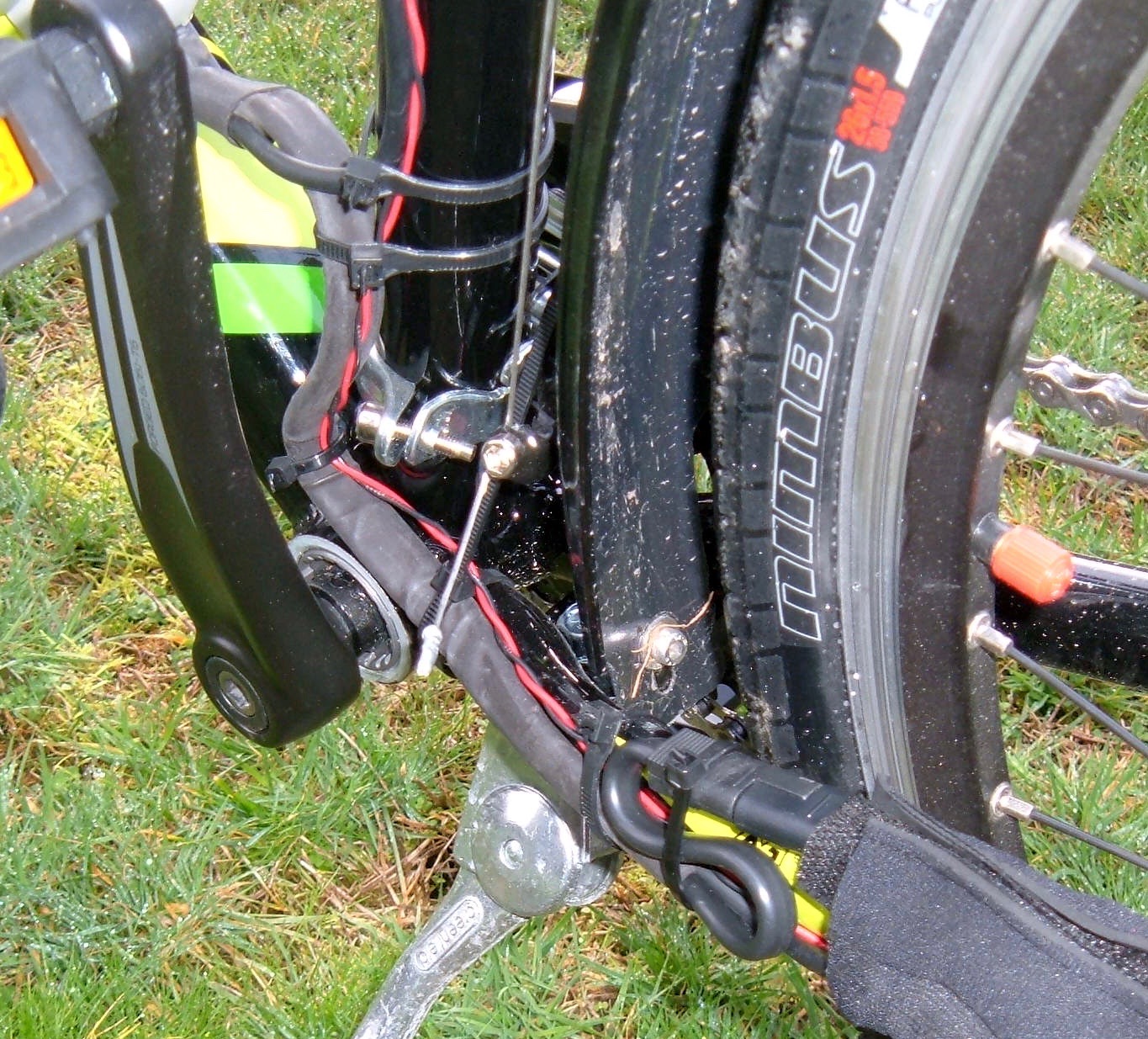
It's remarkably difficult to get this to fit - the cable lengths are matched, and I went and stuck another few inches of power cable in there.  You can see the "S" curve that I made to take up the slack.  The red & black twisted conductors carry pack voltage up to the front of the bike for the lights.

The lights are a pair of "ebike headlights" I got from (surprise!) eBay.  I ordered a bunch of different types, and these are the best I found so far.

The advantage of "ebike headlights" or "scooter headlights" is that they take a wide range of voltages.  Other bike lights I've reviewed were quite picky about their voltage, and wouldn't handle anything outside their designed voltage without letting out the magic smoke.  With a slightly more complex voltage regulator circuit, this variety of headlight can handle anything from 12v to 80v as the input voltage (so it will work on almost anything out there).

I kept the front reflector installed, but moved it to the other side.  I don't need the space for anything else, and while the lights are on any time the bike is powered on, the battery can go dead, so it keeps a reflector.

That said, I'm not actually worried about the battery going dead.  This bike has regenerative braking that can be turned on at any time, so a light level of regen acts as a wheel dyno that will power the lights.  Unless you want the lights to go out, you can keep them on.
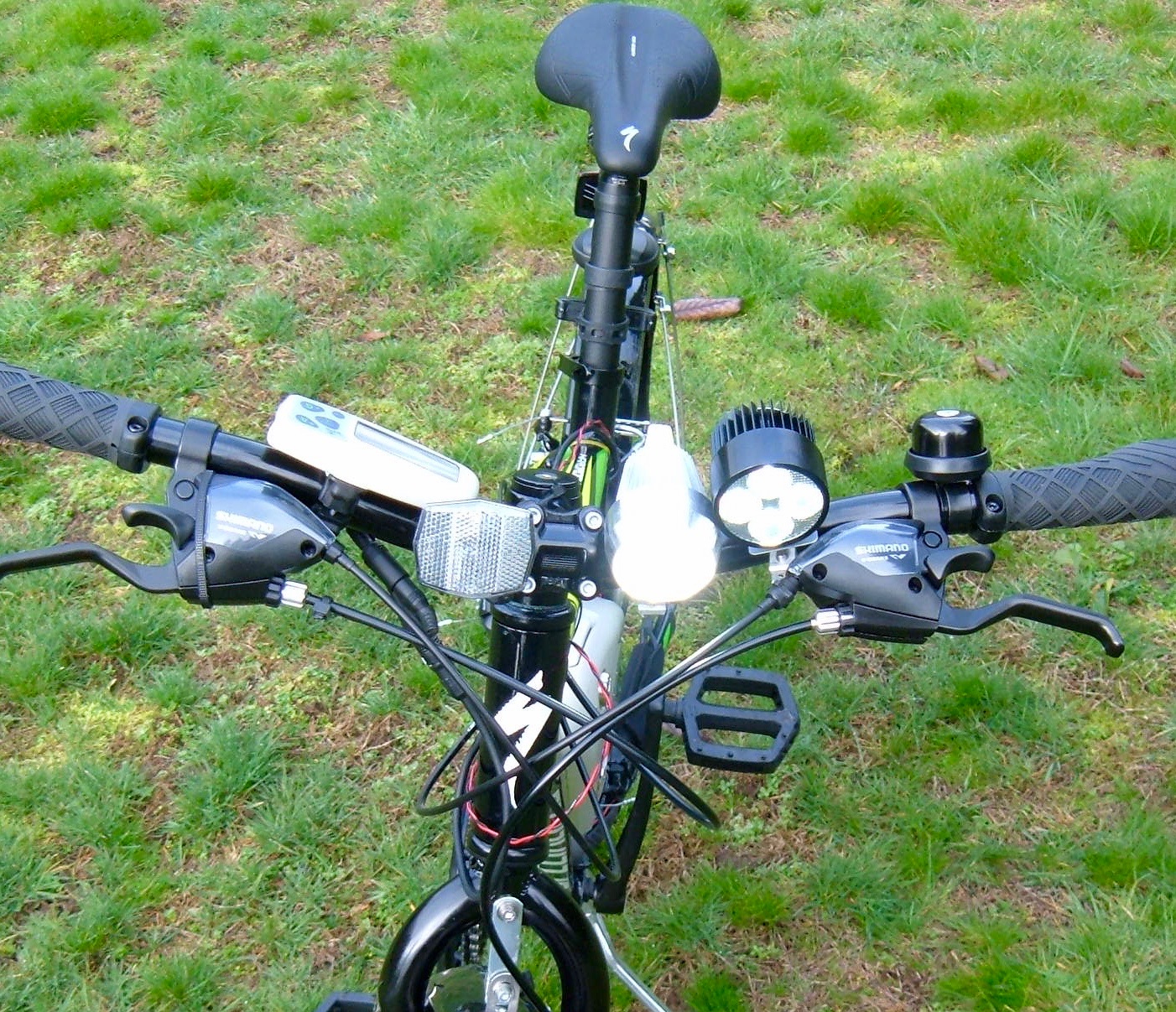

The mounts aren't fancy.  They're just some metal clamps and hex head screws.

But, you know what?  This is about $30 of headlights, and they're pretty damned good.  I've got over $200 worth of lighting on the front of my commuter (a $160 Cycle Lumenator, $50 of random LED lights, and a pair of DC-DC converters to power the lower voltage lights), and there's really no difference in the end result.

Power comes up from the twisted pair of wires, and is split to feed both lights.  There's a set of connectors under the waterproofing tape, in case the bars need to come off.


This provides a good idea of how the lights look at night.  The center core of illumination is overexposed compared to what it actually looks like, but this shows roughly how it looks from the biker's perspective, and about how far you can see.  It's really quite good, especially considering the cost, and more than adequate for the speeds this bike will do at night - even on a pitch black trail.

I've ridden my commuter and this bike on the same trail at night, and this set of headlights is just as good as my commuter set, for a fraction the cost.


Rear Lighting

The rear lighting is a lot less exciting.  I'm using one of the "Laser 5 LED Bike Lights" I reviewed a few weeks back, a random USB chargeable light bar, and the stock reflector.  I've been trying to find a good tail light solution for electric bikes that works over a wide voltage range, and haven't found a reasonably priced one yet.  Grin makes a really nice 8 LED tail light that works at almost any voltage, but it's $60, and I think that's a bit excessive (so, of course, my commuter has it).

In any case, there's plenty of rear lighting on this bike for what it's going to be doing.


Brake Lever & Regen Control

Because this bike has integrated brake levers and shifters, I can't just replace the brake lever with a BionX compatible one.  I need to use the magnetic pickup and provided magnet, which I've done.  This photo is looking at the right shifter/brake unit from the underside.  The cylinder held on with the zip tie and 3M molding tape, and the magnet is also held on with 3M molding tape.  That stuff is really, really useful - I end up using it somewhere on almost all my builds.

The magnet and pickup are set so that a small movement of the brake lever triggers the regenerative braking.  I adjusted the rear brakes a bit loose, so the first stage of lever travel is just motor regen, and it works nicely.


Riding & Hill Climbing

This bike is just nice to ride.  Turn it on, set the assist level, and go.  The BionX system gets out of the way entirely when riding, but there's a smooth assist rising up to help when you need it.  It is, by far, the nicest system I've ridden.  You pedal, it assists, the console does things to show you what it's doing, but you can safely ignore that and just ride the bike like it wants to be ridden.

The bike is happy cruising along at 17-19mph with a low level of assist, and seems to use remarkably little energy getting around (as is to be expected with a pedal assist).  The upgraded pack capacity helps, but I'd expect 20-25 miles of "level 4 assist" with some energy left over for lights, and if you turn the assist down, it'll go as far as you care to ride.

It climbs hills far better than I expected of a 350W system - to the point where I began to wonder if it's pushing more than 350W through the motor.  According to NYCEWheels, the newer 350W kits will peak around 700W, and I would believe it.  I didn't have time to attach a wattmeter to this bike, but it chewed up my muddy pipeline trail test (a long, insanely steep hill filled with mud and gravel) far better than I'd expected.  While it puts out noticeably less power than my 1000W bike, it'll still manage 8-10mph up my "commute hill," and that's a radical improvement over no motor.

The only real downside I've noticed is that it will thermally throttle if you abuse it too much (say, a long, slow climb up that muddy trail).  At some point, it decides things are getting too warm and it cuts the power output significantly.  This is a bit annoying at the end of a hill, but it really does beat frying the motor or controller.

I was excited by the throttle option initially (since I'm used to a throttle based bike), but it turns out I almost never used it.  The pedal assist is a better way to ride this bike.

Regenerative Braking on Bicycles

The PL350 has a regenerative braking mode.  It's activated by the either brake lever sensor or the console buttons, and one can control the strength of the braking regeneration in the settings menu (code 2002, values from 1-64).  Since this bike has rear rim brakes, I turned it all the way up, interested in how much dynamic braking power I could get.

I've long thought that regenerative braking on bicycles is a bit silly.  Yes, you can recover a tiny bit of energy, but the light weight and awful aerodynamics of a typical bicycle make it hard to recover much of what you've put in - rolling downhill, air drag takes most of the energy.

After riding this bike, with regenerative braking available?  Well, I still feel about the same.  It's a nice feature, but I wouldn't go with a direct drive motor just for this.  The amount of energy that can be recovered is minimal, and if you live on a hill and start out with a full pack, the regenerative braking is quite limited - there's nowhere for the energy to go.  So you use your brakes anyway.

If I had a heavy cargo bike and normally charged the battery pack to 90% for longevity reasons, regen might be a useful feature.  But for a single passenger bike, it's just not that important.  It saves your brakes a tiny bit, and that's about all it's worth.

My commuter bike is heavier, a bit faster, and has a geared hub motor - so no regenerative braking at all.  I live on top of a rather impressive hill, with a steep 220' vertical descent in the morning, and the same climb on the way home.  Despite this, I can get 8-12 months of daily commuting from a set of Koolstop Electric Bike Pads before I need to replace them.

If the kit you're looking at for other reasons offers regenerative braking, you may as well use it.  But I don't think it's worth seeking out a specific kit just for this feature, unless you're on a cargo bike.

Conclusions

This was a fun build!  I enjoyed getting to work with the BionX system, and to ride one on roads I'm familiar with (I put 30 or 40 miles on in testing before selling it).

Coming from a 1000W geared hub motor, I thought I'd be underwhelmed by the power delivery - but I wasn't!  It's noticeably less power than my commuter, but the smoother pedal assist really makes up for it.  I work a bit harder on this bike, but on "level 4 assist" it's not much more effort than my commuter build, and I really don't notice the difference.  The exercise is probably good for me anyway.

It climbs hills well, it rides nicely, and BionX has clearly done their homework when it comes to smooth operation.

It may be old, but the PL350 is still a great system!

If you have one that you'd like the pack rebuilt on, let me know with the contact form on the right.  Or, if you have a dead system you're getting rid of, let me know as well!

A Rant About Repairability and Proprietary Systems: Why Electric Bikes Need Rebuildable Batteries

It's the end of February, 2016.  The anti-Trump fortress of "Well, yeah, he's got some support now, but there's no way he can win the primaries" has been thoroughly overrun, and it's occupants are beating a hasty retreat to the stronghold of "Well, yeah, he's winning primaries, but there's no way he can win the general!"  Additional fallback positions may include "Well, he won the general, but he probably won't live to be inaugurated" and the rather dismal cave of, "Well, shit."

UK Censors, after being subjected to 10 hours and 7 minutes of literally watching paint dry in Charlie Lyne's "Paint Drying," were overheard saying, "It wasn't that bad.  It could have been footage from one of Hillary's campaign stops."


Cell Phones vs Electric Bikes

In another bit of news, an electric bike is not a cell phone or laptop.  One of these categories gets old beyond just the batteries, and one of these categories would remain perfectly useful indefinitely, were it not for battery packs dying (like this BionX battery from 2008).


iFixit is a company that does teardowns of shiny new tech devices, many of which are rather difficult to repair.  The vast majority of people don't seem to mind, and talk about how repairability is an obsolete concept, and besides, the device is slow and crufty in a few years anyway.

I find remarkably few people who care about repairability in 2016.  Which, I admit, works to my advantage.  I can turn a tidy little profit repairing phones, replacing batteries, and generally fixing things instead of throwing them away.  One man's trash...

That said, when it comes to phones, I mostly agree.  Technology keeps advancing, cell phones get slow at running the latest apps and websites, Apple doesn't update old enough devices (though I'm currently impressed - the iPhone 4S from late 2011 is on iOS9), and if you're an Android user, well, forget it - what it ships with is probably the only thing you're going to get.

I think this is a problem, but clearly billions of people don't.  At least you can get replacement parts & batteries for old phones.  If it was even a moderately popular phone or tablet, the parts to repair it are available.  Maybe not OEM, maybe out of some some little back alley factory in China, but you can get the parts.  eBay is wonderful for esoteric phone and laptop bits.

This "throw away device" approach to devices falls apart spectacularly when applied to transportation.  From my (admittedly biased) viewpoint, electric bikes are particularly bad about being turned into scrap before their time due to one part.

The "problem" with electric bikes (and electric vehicles in general) is that a bicycle doesn't get obsolete!  It may break and need repairs, but it doesn't get "obsolete" like a cell phone or computer does.  An electric bike from 2008 that worked nicely for transportation in 2008 still works nicely for transportation in 2016 - if you can power it.  The roads haven't fundamentally changed in the last 7 years - or even the last 70 years.

The same is true of other forms of transportation - a car from the 1940s or 1950s is still quite capable of running safely and at speed on today's roads, and bicycles from the 1920s or 1930s are perfectly useful today (a bit heavier than modern bikes, though I don't think today's carbon fiber bikes will be rolling in 2116).

The problem is that keeping an electric bike from 2008 (or earlier) running can be very, very difficult.  At best, if it's been used a lot (awesome!), the batteries are worn out from age and use.  More typically, the batteries are totally dead from sitting off the charger for 6 months or a year (or three).  This wouldn't be a problem if replacement packs were available, but they're not.  Seriously.  Go try to buy a new pack for a Trek Valencia Ride+.  Or a Schwinn Tailwind.  I'll wait.  They look like this.


Options for a Dead Battery

If your battery is a simple "Volts & Amps" style battery with no communication other than voltage, the solution is easy.  Go buy a new battery of similar voltage, connect it, and ride.  You'll either have more range for the same weight, or a lighter battery.

However, an awful lot of electric bikes from that era (and today is no better) have proprietary communication channels, fancy BMSs (that didn't do their job, like this Tailwind BMS), and are generally not easy to swap out for something newer.


This leaves a few options for people stuck with a dead proprietary battery:
  1. Scrap the bike.  Accept that you purchased a bike with a 3-5 year lifespan, and when it's worn out, you junk the whole thing.  Or replace all the expensive electric bike parts with new, also expensive electric bike parts.  Or just scrap the electronic parts and be left with a less-than-ideal bike for non-motorized use.  I think this is utterly absurd, but it's depressingly common.
  2. Try to find "new old stock" batteries that still work.  They exist, but they're often not in great shape either - at best, they don't have cycles on them but they still have years on them.  Good luck.
  3. Rebuild the battery pack.  This is what I do.  This is what Trek and BionX are making a very difficult process, and Schwinn has made basically impossible.
  4. Bypass the battery pack at some convenient point, and hook up external batteries.  This is what some other people try to do.  Depending on the system, it can work, but the BionX systems require opening the pack to do this, which can be very difficult.  This also requires internal batteries that hold a charge.  It's a valid hack for capacity loss, but it's not a safe fix for dead batteries.
None of these are amazing options for people who would like to keep bikes running, and many of them require specialized technical skills that are beyond what most bike shops are willing to do.

So, a simple request for those people designing electric bikes: Consider the people who will want to keep them running.

Keeping Electric Bikes Running

If you, as a designer of an electric bike, don't think anyone will want to keep your bike running in 5 years, then you must think it's a piece of crap, and you should ask yourself why you're selling it in the first place ("But Crowdfunding!" is certainly an answer, if a rather slimy one).

However, if you think you've designed a good enough bike or conversion kit that people will want to be riding it in 5, 10, 15 years - why are you making it difficult to repair?  Your batteries won't last forever in the best case, and they'll last a lot shorter in the common case.  If you've built a good bike, consider that people still ride bikes from the 50s and 60s, and design accordingly.  Make it easy for people who want to rebuild your packs!

I have no complaints about the downtube mounted BionX 36v packs.  They're reasonably easy to get apart, and rebuilding them is not a hard process.  BionX won't sell you a new battery for older systems - the best they'll do is offer you a loyalty discount on a brand new system (spoiler: they're not cheap).

The Trek Valencia Ride+ pack?  What were you thinking?  I see no reason whatsoever to use aggressive foam adhesive in holding this pack together.  Compressible foam would work just as well for holding the cells in place, without making it nearly impossible to rip open for rebuilding.

The Schwinn Tailwind pack?  Forget it.  They won't even talk to you.  Schwinn tells you to call someone who has nothing to do with building Schwinn's batteries, and Toshiba tells you to call Schwinn.  It's totally abandoned by everyone involved in making it, and it's got an oddball battery chemistry as well - lithium titanate, with a fancy, sophisticated BMS that nobody knows a thing about (except that they end up reliably not working).

I understand that the manufacturers are worried about liability, or lawsuits, or something.  Knock it off.  If it fails in warranty, it's your problem.  If it fails after that, it's someone else's problem, and if you think your product is any good at all, it's likely that they'll want to keep using it.  Don't get in their way.

Requests to Electric Bike Manufacturers

  1. When designing your packs, consider that they are a finite lifespan item on a bike that can and should last radically longer.  Consider end of pack life rebuilding when you're designing a pack.
  2. Provide full technical information on your packs when you no longer sell them.  If you're not selling them, you can't lose out on sales from third parties rebuilding, but you can make customers happy with your brand going forward.
  3. If you build a "kill switch" into your BMS for low voltage conditions, document how to revert it once the cells are replaced.  "Use the proprietary software random users cannot get" is not an acceptable option here.
  4. Don't design to prevent owners from using a third party battery pack in the long term.  It's fine if you don't interface properly with it, but at the very minimum, don't refuse to operate without the provided battery pack.  I should be able to put "Volts & Amps" across a set of terminals and have an operating electric bike.

Thoughts for Buyers

Ask about this before you buy an electric bike.  Consider that if you buy one, you may well want to keep riding it past the first battery lifespan.  If the battery pack is a glued together pile of proprietary nonsense only sold for a few years, you might not be able to do that.  And, even if there is someone who can rebuild it, you'll pay more and get back a pack that has been pried apart with excessive force.  It's not an appealing situation, is it?

This really is something to consider if you're buying an electric bike.  I love the nicely integrated stuff, but if you want to keep it running for a few decades, the cheap parts out of China are simply better.  They interface over a well understood set of unofficial standards, and they interoperate surprisingly well.  Volts & amps go in, forward motion comes out.  You can mix and match parts at will.  Is it as nicely integrated?  No.  But it'll be poorly integrated and functional while rolling down the road under it's own power, which is better than you can say about a BionX system with a dead battery.

If you're stuck with a dead ebike, I'd love to hear about it in the comments.  I care about keeping older stuff running, and I'm slowly building my list of packs I can successfully rebuild.  If you've got a pack I don't know, I offer a nice discount on the first rebuild of a new type, if I can rebuild it.

My Daily Driver Bike One Year Review: Boring and Reliable


This is my commuter ebike.  I've had it for over a year now.

I've been riding it about 9-9.5 miles/day since I built it - pretty much every weekday, rain or shine.  This, plus weekend riding and store runs, works out to about 2500 miles.

In this year, I've replaced the following things:
- Chain (stretched beyond wear limits)
- Rear freewheel (torn up by the stretched chain, partly because I mostly use the small sprockets)
- Rear brake pads (worn, replaced with KoolStop Electric Bike Pads)
- Front brake pads (same as the rear)
- Rear tube (took a huge nail, but I was able to ride home due to the slime in the tube)
- Throttle lever (the thumb bit snapped off).

None of these left me stranded, and only the front brake pads required minor side-of-road tweaking (the pistons weren't retracting properly with the pads worn out and the brakes were dragging).

In terms of maintenance required for a daily driver, this has been insanely low.  I've spent around $100 on parts, total.  And about $7 on electricity to power me these 2500 miles.

The only major additions have been more light up front (powered by a DC-DC converter I built) and a set of bike balls.

At this point, I can confidently state that this bike is exceeding all my expectations!  It's somewhat overbuilt for my needs (which was half the point - pushing limits on a daily driver is a way to have an unreliable bike), but it chews up hills easily, is cruising well under rated power, runs cool, and generally is an incredibly boring ebike - which is exactly what I wanted.  It just works.

I've got a 15-20 mile range on my current battery pack (36v, 13.3AH LiFePO4), a top speed of around 23mph on flat pavement, and while I have to pedal some to get up hills, the motor covers the bulk of my power needs.

The fenders do a very good job of keeping the wet road grit off me, though I'll still take some splash on my shoes from the front wheel if there's standing water.  The rear fender works perfectly - my backpack has zero road grime on it.

The triple layer of armored tires, heavy duty thorn resistant tubes, and slime also works exactly as I'd hoped.  I've only had one tire problem in a year of commuting, and that was a rather large nail.  Even with that, I was able to make it home riding - I consider this a huge success of my tire system.

I'm incredibly happy with this build, and would absolutely encourage anyone considering a commuter to go for the "somewhat overbuilt" approach to reliability.

How far can you ride an electric bike on the power it takes to produce a Model S battery pack?

A truth of modern industrial society is that it takes energy to make things.

Sometimes, that energy is better spent doing things than making the thing to save energy or "be green."

Let's consider a Tesla Model S battery pack.  The shiny new one is 90kWh.

How much energy does it take to build a 90kWh pack?

http://www.lowtechmagazine.com/2015/05/sustainability-off-grid-solar-power.html makes some claims about lithium battery embodied energy.  It claims:
According to the latest LCA's, aimed at electric vehicle storage, the making of a lithium-ion battery requires between 1.4 and 1.87 MJ/wh
How much is that?  1MJ = 0.278 kWh = 278WH.

I'll be nice and use the lower end for Tesla's batteries. 1WH of lithium battery takes ~390WH to produce.

A Model S 90kWh pack, therefore, takes ~35MWh to produce.

http://seekingalpha.com/article/1261431-why-batteries-are-too-valuable-to-waste-on-solar-power-integration-and-electric-cars also does some math on the Tesla packs.  Their number is 472WH per WH of battery.
Based on an embodied energy of 472 kWhe per kWh of battery capacity, the Tesla's 85 kWh battery pack will have 40,120 kWhe of total embodied energy.
Well, 40MWh is within a reasonable tolerance of my numbers, so I'm happy enough with my back of the envelope calculations.

How far can that 35MWh take an electric bike?

A throttle-based ebike will consume somewhere around 35Wh/mi.  So... a million miles. :/

What if we use a pedal assist bike at 15-20Wh/mi?  Near as makes no difference, two million miles.

A typical American car travels 12k miles/yr.  If you drive for 80 years, that's 960,000 miles.

So... for the energy involved in creating one Tesla Model S battery pack, you can ride an ebike for your whole life.

Ouch.

Schwinn Tailwind Review (in 2015)

The Schwinn Tailwind.  The name sounds powerful, fast, and sleek!  It sounds like the type of thing Snoopy might fly into combat against the Red Baron.

It's not a half bad looking bike, either!  But... is it any good?


As you've probably guessed if you read this blog frequently, you'll have to read on to find out!


Some History

The Tailwind was announced in late 2008, and came out in early 2009, retailing for a rather high (at the time) price of $3,199.  It promised all sorts of interesting features (well, mostly, it was an electric bike by a major name in bicycles), came with an exotic Toshiba SCiB battery with super fast charging, and very successfully got the attention of many tech and bicycle websites, who happily covered this amazing new development in transportation.  It also managed to get coverage in a lot of business-focused magazines - which is unusual for an electric bike.  I'll come back to this later.

Surprisingly few websites seem to have actually gotten around to riding the thing when it came out.  Most of the reviews seem to be "paper reviews," with a few reviews written by people who had never ridden an electric bike before, rode it briefly, and came away impressed (not a high bar).

It doesn't seem to have been a very popular bicycle.  Actual rider reports are few and far between.  As is often the case for expensive, weird, new things that don't have a well defined use case, within a few short years, the bikes were being closed out for under $1000.  They were down to $700 in 2013, and can now be found for $350 with bad batteries on eBay.

Of course, as some of my regular readers might know, I bought one.  With a bad battery.  And bypassed the BMS so I could actually ride it.  And review it.

This is a 6-7 year old bike, and my particular example has been ridden a good bit, so it's not in perfect condition.  But I can still review it and provide some feedback on it for people who otherwise wouldn't be able to find anything recent.  Or, at least, get some good detail photos of parts otherwise not covered.

Design Features Review

I'm just going to start at the front of the bike and work back.  There's a lot of weirdness to cover.  Some of it is good, some of it less so.

Fundamentally, this bike seems like a bunch of parts bolted and ziptied (yes... literally ziptied) onto an otherwise standard Schwinn city bike frame.


In fact, the parts are bolted onto on the Schwinn Urban Tuned City Geometry with N'Litened 6000 Series Aluminum.  If you care about such things.


Front Wheel, Forks, and Motor

This bike is powered by a small front hub motor.  It's a brushless geared motor (excellent!), and supposedly rated for 180W sustained/250W peak output, though I haven't stuck an ammeter on it to verify the power consumption (and, sadly, I lack an ebike dyno).  It claims 220W on the actual motor.  So, it's something in that range.  The controller for it is zip tied on a fork tube.  Count the zip ties, for fun.  This bike is crawling with them.

As is standard for geared ebike motors, it has no significant rolling resistance when the wheel is turning faster than the motor.  It's not a bad choice for a small assist - it's not going to cause any drag when you're not using the assist, and it's fairly light.  There's no regen, though.  As this bike isn't at all suited to hills, this isn't a problem at all.


The front brakes are standard rim brakes.  They're nothing special, but they work quite well.  Wrapping the front wheel is a decent enough fender, though it terminates a bit higher in the rear than I'd like for the wet Seattle winters (road spray).

The front fork is an adequate SR Suntour Nex 4610 with adjustable preload and suspension lockout.  Why you need suspension lockout on this bike is actually quite beyond me.


This is the front light (a Lumotec Oval Halogen) and reflector.  It's powered by a generator from the rear wheel.  The light... lights up.  It's incandescent.  It doesn't get very bright.  I'm not really sure what it's point is since it's not very useful at night, but it does have a front light.


Handlebars

The handlebars are a bit unusual.  For starters, they're super swept back.  They sweep back at a ~30 degree angle, which is very unusual for most bikes.  They feel like they're almost in your lap while riding, which is a weird feeling.


The left brake lever controls the front brakes and the right the rear, as is standard.  On the left bar, there's the controller for the motor.  It has a basic on/off toggle, a battery level indicator, and a power mode button that toggles between low, medium, and high.  I think the diagram above it shows that you're supposed to use low when descending a hill, med on the flats, and high when climbing, though the riding position for that cyclist is radically more aggressive than this bike allows.  You can easily switch between power modes, and this is the closest thing to a throttle the bike has.


On the right is the shifter for the Shimano Nexus 8 speed rear hub.  It shows you what gear you're in (1 is low, 8 is high), and you twist it to shift.  Quick, easy, and when properly adjusted, surprisingly nice.  I really do like this controller for the shifting.


Pedal Drivetrain

The pedal drivetrain on this bike is different from any other I've ridden, and I really, really like it!

It's using an internally geared rear hub with a straight chainline, well protected inside a plastic housing to keep it clean and to keep you clean.


I'll start at the front interface to the drivetrain.  The pedals are nice metal units, with a grippy rubber strip around them.  These are definitely easy on the feet or shoes, and are perfectly fine for barefoot riding, should you care to do so.  They seem to be quite strong units, and I wouldn't expect any problems with them, ever.


The (mostly) sealed drivetrain!  There are four or five pieces of plastic that clip together to seal this thing up very well.  Road or trail grit will stay out, and chain oil will stay in.  They can do this because all the shifting is done in the rear hub - so it's a straight, simple chainline with nothing other than two sprockets and a chain.  I really, really like this feature - I can ride it in long pants and not get dirty, and if I take it on a dusty trail, the chain will stay clean and grit-free.  This is awesome, and I'd love to see more bikes doing something like this.

It is a bit of a pain to remove if you have to change a flat, though.  Slime the tubes and call it good, because this really does make riding less messy.  No more pant-leg-in-sock rides to the stores, followed by forgetting about it and walking around for another few hours with your pants crammed into your sock!


At the back end is a Shimano Nexus 8 speed rear hub with a rollerbrake for braking power.  The internally geared hub is fairly obvious (8 speeds, with a set of internal gears), but the rollerbrake was something new to me.  It's a totally sealed brake unit, similar in some ways to a coaster brake, but applied via a standard brake lever.  That it's sealed means it's totally immune to rain and dirt - which is awesome!

Downsides include complexity, lack of repairability, and adequate braking at best if you have hills.  The braking feel is also very springy - there's no real feedback in the lever, just an increasing force that goes all the way to the bars, and increases braking effort.  It might lock the rear wheel up on ice, but that's about it.  Fine on the flats, though.


Seat, Wheel Lock, and Generator

I'm quite impressed with the seat on this bike.  It's a good blend of "comfortable while sitting on it at the store" without being horrendous to actually ride.  It's, obviously, 3D - I really hate those 2D seats, so this is a good one.  Or... something.  I'm not sure what the 3D label is for, actually.

In any case, it's one of the better stock seats I've seen on an electric bike so far.  Nice job here - this seat is absolutely suited to what the bike is good for.


An interesting feature I've not seen before is a wheel lock.  The upper horseshoe-shaped thing is a keyed wheel lock that lets you run a metal bar through the spokes.  This keeps the rear wheel attached, and also prevents someone from biking off with it.  It's no substitute for a chain, but in a friendly community (such as a retirement community on a lake somewhere), it's probably good enough.

Below the wheel lock is the generator.  For the lights.  On an electric bicycle.  sigh  Also, you'll see more zip ties, holding the generator wiring in place.

If you start from the assumption that the electric assist is a best-effort system, and that you'll rapidly exceed it's range, this makes some amount of sense.  But not much.  Lights just don't take much power, and a generator, rubbing the wheel, is annoying and noticeable.


If you look closely, you can see the metal bar sticking through the wheel.  Also, the switchblade key is visible, inserted into the lock.  There are two keys for this bike.  One for the lock, one for the power.


The wheel lock is a Basta Defender, if you're curious (apparently now, the AXA Defender).


More zip ties holding the wiring harness in place.  The Tailwind parts really are literally zip tied onto a standard bicycle frame.  Some bolts, but mostly zipties.


The Back End: Battery & Lights

On to the last part of the bike - the back!


The rear rack holds the battery pack, the contacts for the battery pack, and comes with a nice elastic strap for holding things down.  I really like the elastic strap!

Two things to notice here: The keyed switch, on the left, and the pack release lever (red), on the right.

You have to turn the switch on first, then turn on the bike from the handlebars.  I suspect this is designed to reduce battery drain when idle, but it doesn't really work.  And it's annoying.  There's not a great spot for the wheel lock key, though you can sort of wedge it into the frame if you try.

The second thing to notice is the battery pack removal lever.  If you have a key on an electric bike with an expensive, exotic battery pack, it might make sense to lock the pack into the bike somehow.  Nope!  The pack is always free to slide right out.  It's the easiest pack to remove I've ever seen.


Here's some detail of the two keys.  The left one turns the bike on, the right one unlocks the wheel lock.  I really don't know why they went with two keys... (actually, I do - it's because the parts were sourced from different manufacturers, and this was the easiest thing to do)


Finally, the rear LED tail light and reflector.  Mostly, it's a reflector.  The tail light does glow somewhat, but it's not very bright, and it goes out as soon as you stop moving.

You shouldn't ride this bike at night without some other source of lighting.  Or, at least, replace the generator with a small battery pack.

You can see where the power for it comes through the fender and wraps around.  However, there are no zip ties here!


Finally, just because I think it looks cool, the logos on the frame.


Riding It

Riding this bike is easy enough, once you remember to turn the key on.  Turn the key on back at the battery pack, then turn the handlebar controller on (if you want the assist), get on, and start riding.

Riding Position

The most obvious thing about riding this bike is the riding position.  It's upright.  Super, super, incredibly upright.  Imagine you're an 80 year old man.  Get your pants hiked up to just below your sternum.  Make sure to get your suspenders nice and tight.  Put on your best loafers, your town cruising hat, and carefully step onto this bike.  Don't bend your back at all!  Vertical!  There.  You've imagined the riding position on this bike.

The bars being swept are a big cause of this, but the end result is that you do feel like an 80 year old man.

Pedal Assist

The motor assist on this bike is purely pedal assist, though it's more fair to call it "pedals are moving, motor is on" - since that what it seems to be.  Start pedaling, and the motor will chime in at some power, mostly dependent on what you've set on the handlebar control.  It pretty much does that until you stop pedaling or hit a brake lever.  Very simple.  Do recall that this bike was designed around 2008, so a lot of the more modern stuff didn't exist.  However, BionX was around, with their I2C torque sensing motors, so there's at least some better stuff available.

A neat little perk of this system is that if you drop down to a low gear and spin the pedals freely, the motor will still power you along.  I'm sure it's not doing good things to the range, but it works!

On the flats

On flat ground, the bike is heavy but livable without the assist.  The rear hub shifts quickly, and it's nice to have a full range of gears without having to think too much about it (though, my commuter build also has this feature).  It's impossible to get the chain crossed up or do anything bad to this setup.

With the assist running on low or medium, the bike rolls smoothly and lightly, and the assist blends smoothly with pedaling.  It can actually be hard to tell if it's working or not, until you tap the on/off switch and realize, yes, it's helping out nicely.  There's no need for the max assist level on flat ground.

It's not fast - you'll cruise comfortably at 12-14mph, maybe a bit faster if you pedal, but this is a rather slow running bicycle.  It's not built for going places in a hurry.  You're also not going to tuck down over the bars, ever.  Good luck if you've got a headwind.

For running slowly on flat terrain, the brakes are just fine.  The rear brake, if a bit springy, will get you stopped, and the front chimes in quickly to bring you down in a hurry if you need to.

Hills

Ah.  But you have hills, you say.  Well then.  That changes everything.

If they're shallow hills (perhaps, what Iowa calls a hill), you're fine.  If they're steep hills (Seattle style), get another bike.

Steep hills lead to several significant problems on this bike:
  • The gearing doesn't go low enough.  Grinding up a steep hill, gear 1 is not low enough.  And you can't really stand on the pedals - the bike ergonomics make it nearly impossible, and also that level of torque is apparently a reliable way to break a Shimano Nexus rear hub.
  • The motor just doesn't help that much.  It's only a 250W motor.  Even at full output, it's better than nothing, but only barely.  It'll help you slowly grind your way up the hill, but it doesn't want to be doing it.  Hopefully it doesn't drain the tiny battery midway up the hill, or you'll find yourself walking.
  • The steering gets very loose when grinding up a hill.  With the front motor turning up a steep hill, it's putting enough load on the front wheel that the steering will no longer self center, and it's very vague and floaty.  It's somewhat disconcerting.
  • The rear brake won't slow you down much going down a steep hill.  Hopefully your front pads are in good shape!  Also, if you do insist on dragging the rear brake down a hill, be aware that the rollerbrakes can suffer permanent damage from overheating, and can't be rebuilt.  So there's that.
Seriously, if you have steep hills, this is not the bike for you.  It's absolutely terrible with steep hills that other electric bikes chew up easily.

Electrical System

I've covered the battery pack elsewhere, in great detail.  Also, how to bypass the BMS if it's gotten unhappy.

In a nutshell, it's a 24v, 4AH battery pack composed of reasonably exotic lithium titanate cells.  They're a Toshiba SCiB unit, and have, on paper, an insane cycle life.  Though the BMS doesn't seem to help this much.

By modern terms, it's a tiny system - only about 100WH (watt-hours) of capacity.  Also, by some of it's competition at the time, it was a tiny system.  The BionX 36v system from 2007 packs over 350WH of capacity into a smaller battery case - though the BionX system actually uses the full case, instead of having a small battery tucked inside a large case.


Why did they go with this system?  It doesn't make much sense to me for an electric bike - the focus on fast charging and a high power density chemistry on a bike that really doesn't need much power is hard to understand.  The only thing I can think is that they hoped it would become a delivery fleet bike or something - but a decent delivery rider would absolutely smoke this bike in any terrain.  So that doesn't make sense either.  It makes sense, if you're Toshiba and want to advertise this fancy battery chemistry you're gearing up to produce, though.

The motor can draw over 200 watts at peak output, so the battery pack is good for less than half an hour of full assist before it's stone dead.  Fortunately, it doesn't run at full assist all the time.

Charging

To charge the battery pack, you have to take it out of the bike.  It comes out easily, but this is quite annoying, given that you charge the bike pretty much every time you ride it (or, at least, you will be, with this small a pack).

Fortunately, if you care about such things, the battery pack charges quickly.  The "slow" home charger charges it in about half an hour (8.4A charger, 4AH pack), and I hear that the fast charger can charge it in about 10 minutes.  That said, I've never seen a picture of the fast charger, and am not entirely convinced they actually exist.  Please let me know if you have one or have a picture of one!

If you need to bring the pack inside to charge, you'll love this setup.  It slides right out, and has a nice handle to carry it.  It's not particularly heavy, either.

Why you'd need to fast charge an electric bike is another story entirely.  I'm not convinced this is worth much of anything, especially when it comes with a tiny battery capacity.  I'd much rather have a large, long range, slow charging pack than a tiny, short range, fast charging pack.  Especially when the charger is so darn heavy!

On the plus side, the pack should be good for something like 10,000 cycles.  Based on the spec sheets.

Why does this bike exist?

I don't know.

It got a lot of positive press for Schwinn and Toshiba, but it's not a very good electric bike.  Even when it came out, the 350W BionX packs were setting a standard, and this bike missed it - badly.

It's a heavy city cruiser with a little bit of power bolted on, driven by a battery pack that makes no sense except as a way to gather press for a particular type of battery.

The SCiB batteries are power dense, charge insanely fast, are proprietary and un-obtainable by normal people, and just don't make sense for an electric bicycle.

The fast charging capability makes it seem like it was focused on fleet use, perhaps for urban delivery.  But it's just not a good bike for this - it's heavy and slow.  A delivery rider with a decent bicycle would just dominate this thing in all terrain, hill or not, and if they did want an electric assist, they'd probably go with something torque sensing and powerful, like a BionX system.

There are a lot of good ideas on this bike, but it still feels more like a bike designed by a committee that was told, "Build an electric bike so we can get some great press!" than a group that actually understood electric bikes, or even had a real mission for this bike.

Should you buy one?

Ah.  This is a good question.  Maybe.  Even though I don't like it, it's got a major redeeming factor.


If you buy one, you'll almost certainly have to bypass the BMS.  If this doesn't intimidate you, you live in the flatlands, and you don't mind the style and riding position of a bolt upright bike, then go for it.  $350 plus a bit of time and effort for a working 250W ebike is an amazing deal.  Throw some bags on the rear, and you've got a great little flatland bike for grocery runs or potting around your retirement community.

If you live anywhere with hills, though, forget it.  Get something better.

Oh, and don't expect a single bit of support from Schwinn or Toshiba.  I've tried.  Neither one wants anything to do with this bike anymore, and they won't help you a single bit.  They've entirely abandoned it.  You are fully on your own.

But, another thing to consider is that the Shimano Nexus 8 with Roller Brake retails for around $250 alone - so if you want one, this one comes with a whole 700C based electric bike attached!  Throw a better battery and a better controller on it, and I bet you can get a whole lot more than 250W out of the motor as well.  Not something I'm going to bother with, though.

Final Thoughts

I've been riding this bike for a while, trying to get an idea of what it is and what it likes to do.

Seattle is definitely not the place for it - it struggles badly with hills.

That said, I love the mostly sealed chainline and rear hub.

But... in 2015, it's just not very good.

Schwinn tried for something.  If their goal was a lot of media coverage for them and, more importantly, Toshiba, they succeeded.  But if their goal was to build a good bike, I think they failed.

Is the bike you're looking at a toy or a tool?

You're looking at a shiny new ebike on some indiekickbay website.  Is it any good?

Good question!  That depends on what you're about to do with it!  Play with it on the weekends in the summer, or ride it to work every single day, wear it out, repair it, and keep it rolling?

My bias here is clear: I commute on an electric bike, love them for that task, and want to see more commuter-ready electric bikes on the market.

There are an awful lot of electric bikes on the market today - they cover a huge amount of ground, from little 250W assist units to things like the Stealth Bomber and a lot of homebuilt ebikes that are full on electric motorcycles with pedals.  However, some of them are better suited to commuting, and some are better suited to being weekend toys.

This is a list of things to consider when looking at an ebike, and might help you decide if it's better suited to being a toy or a daily use tool.  I'm deliberately not listing brands or specific projects here, because I expect an endless stream of these things, and I don't want to be responsible for keeping up with them.  I'd rather be riding. :)

And, don't get me wrong - there's nothing wrong with a toy.  It's fun on the weekend, and you may very well be looking for something like this - but if you try to use it as a daily commuter, you might find yourself wanting a lot more.

Interested in things to consider?  Read on!


Toy

Your default assumption about some new crowdfunded bike should be that it's a toy.  It's sad, but (so far) true.  Most of the bikes that have come across the crowdfunded ebike path are questionable, at best.  It's really sad, but it's true.

Some signs you might be dealing with a toy:

  • Incredibly optimistic range numbers, with no data to back them.  If it's cheap, and it's claiming a 50+ mile range, the manufacturer is probably full of crap.  You can ride any electric bike any distance, if you don't use the motor.  That's not what people want to know.
  • A significant lack of battery pack data and numbers.  You want, at a minimum, voltage and amp-hours of capacity (or the combined value, watt-hours - calculated by multiplying voltage and amp-hours).  A 100-150Wh pack is tiny, a 350-500Wh pack is reasonable, and a 800+Wh pack is huge.
  • A focus on charge time instead of saying anything else about the battery pack.  Hint: It just doesn't matter.  Unless you're running a delivery bike fleet.  Then you still want something quality, not cheap.
  • No mention whatsoever of the battery chemistry.  This makes a huge difference in terms of longevity and safety of the pack.  "Lithium ion battery" is not a chemistry specification.  Also, if it's using anything that's not lithium (lead acid, NiMh, etc) - just stay away entirely.
  • Complete lack of lights and fenders.  A commuter needs these.  A sticker saying "Do not ride at night" is a poor substitute.
  • Only one frame size offered, or no sizes even listed.
  • Videos that show you doing things you'd never do - riding down the beach in the sand, climbing the side of a mountain, etc.  If you actually intend to do these things, that's fine, but most people aren't going to be commuting on a beach.  If you are, I slightly hate you.  Also, most bikes that show these things in videos seem to be poor at actually doing them once shipped.
  • Little or no mention of the hardware used for the "bicycle" part of it - which probably means it's the cheapest things they can find.
  • It uses rim brakes.  In 2015, this means you're focused purely on cost.  Good luck stopping on a downhill in the rain.

Tool

On the other hand, there do exist some very solid looking ebikes that, at least as advertised, appear to be quite solid.  They tend to be rather less over the top in advertising, and usually have a lot more detail offered about the bike and the details of it.

  • The battery pack will be well defined.  Voltage, amp-hours, and ideally some mention of the chemistry (LiCo, LiFePO4, LiMn, etc).  If it's anything other than LiCo, this is a plus - the energy density is lower, but the cycle life is longer, which means you won't have to replace your pack as soon.
  • The range numbers are reasonable.  You can safely ballpark 15Wh/mi for pedal assist, and 25-35Wh/mi for throttle.  Bonuses if the numbers are shown for different weights/road conditions (hilly terrain takes more power than the flats).  If the battery pack and the specified range numbers look about right based on this value, it's a good sign that the range isn't radically inflated.
  • Lights & fenders are included.  You'll really want these if you're commuting, and someone that includes them is very likely considering commuter use in the design.  Be sure the fenders are useful, though - there have been bikes with very "artsy" steamed wood fenders that were radically better at looking good than at keeping the rain off your back.  Tightly fitted, curved fenders that drop down quite far are what you want, at least if it rains.  If it doesn't rain where you are, it doesn't matter.
  • Multiple frame sizes.  Bizarrely, a 5'1" woman needs a different frame size than a 6'5" man.  If the bike comes in multiple sizes, this is a good indication that someone who actually understands bicycles is involved and has thought it through.  The frame fit is slightly less important with an electric bike, but it still matters, especially if you're going to ride it every day.
  • It's a good sign when the videos show commuting, preferably in the rain, or on hills.  This matters if you're going to be commuting in the rain on hills!  We can't all live in Southern California, where it's 70 and sunny all year...
  • The manufacturer of the bicycle components is specified.  If they're willing to specify the manufacturer of the shifters & such, it probably means they're not generic garbage.
  • The bike uses disk brakes.  Preferably, hydraulic disk brakes, if you're in a hilly area.
  • Any mention of armored tires, heavy duty tubes, slime in the tubes, or other anti-flat-tire systems.  A flat tire on a commuter really sucks, and with a motor, the weight of hauling a very robust tire/tube system around doesn't matter.

Not all of this may matter to you, but it's something to keep in mind when you're considering buying a bike from one of these places.

If it's a daily commuter you're looking for, you want something that is going to be easy to maintain.  Bicycles don't last forever without maintenance, and something well built will also be easier to maintain in the long run (through a combination of less maintenance required and easier-to-find parts).

And if you're looking for a cheap toy bike to play with on the weekends, that's fine!  Just don't expect something reliable, maintainable, or particularly good at being a daily rider.

What other things have you found that help you separate the awesome daily commuters from the once-a-month rubbish?